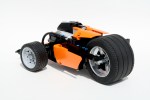
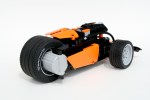
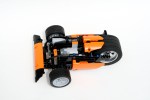
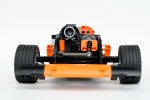
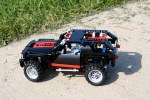
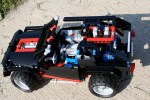
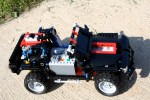
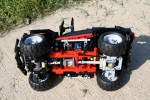
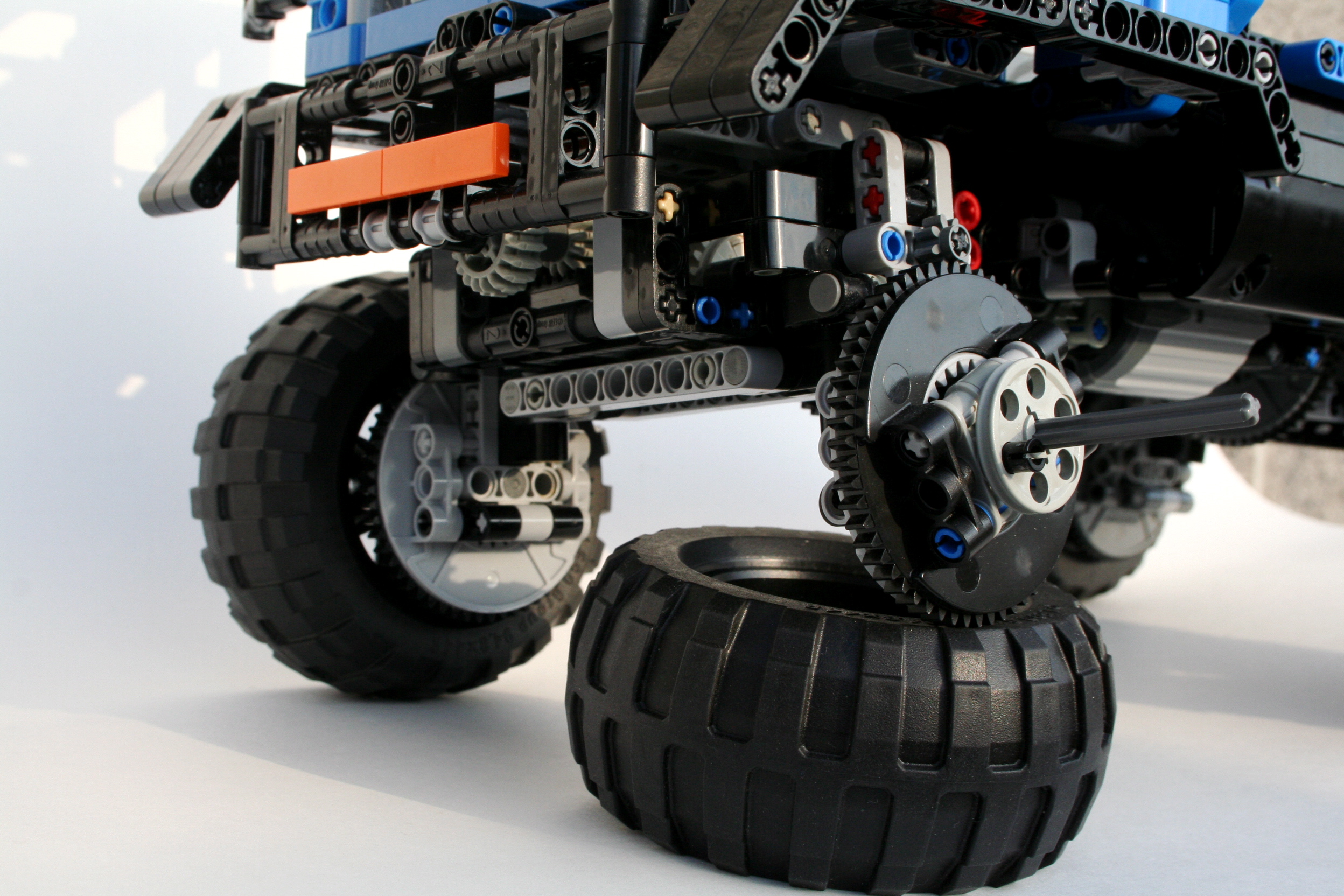
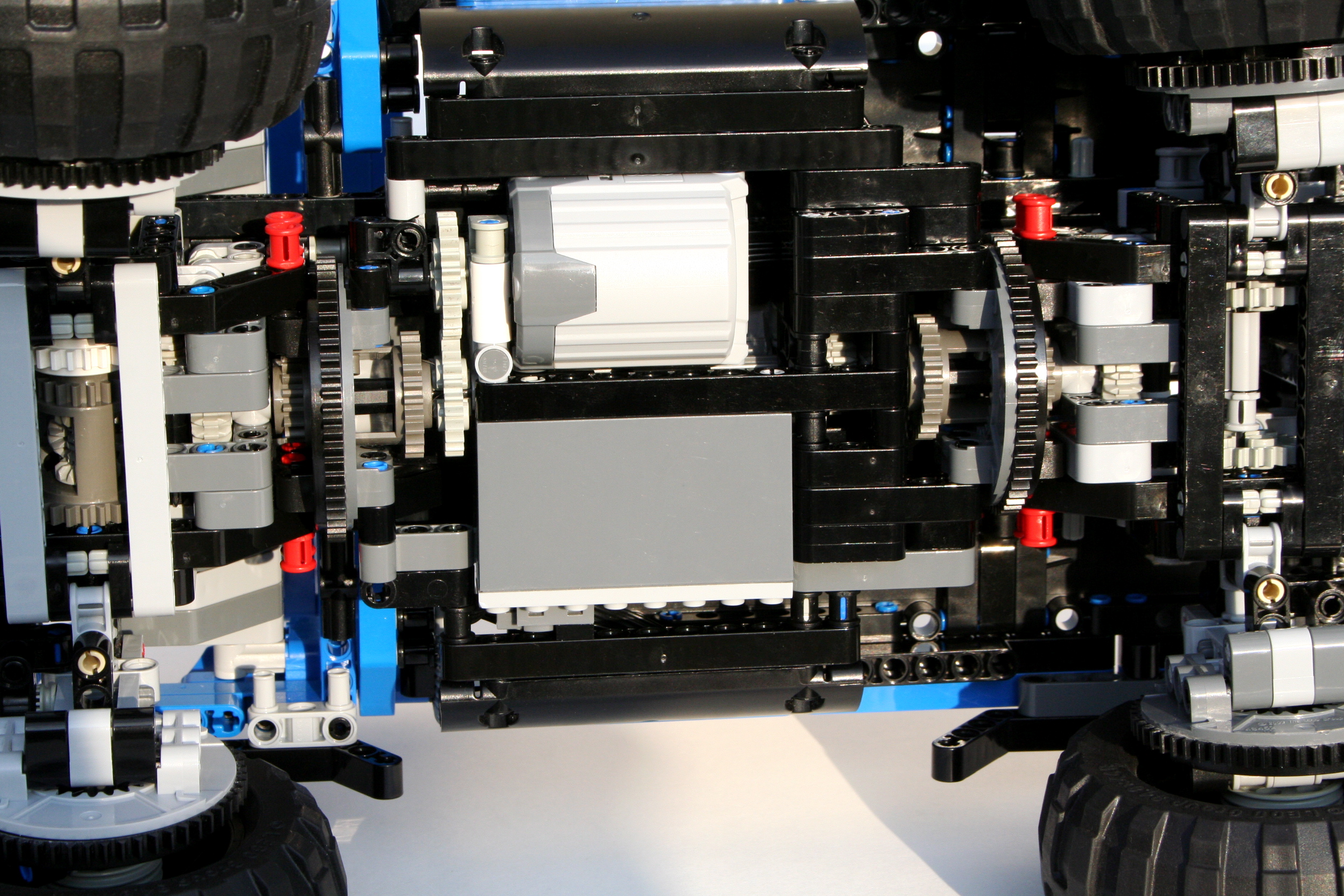
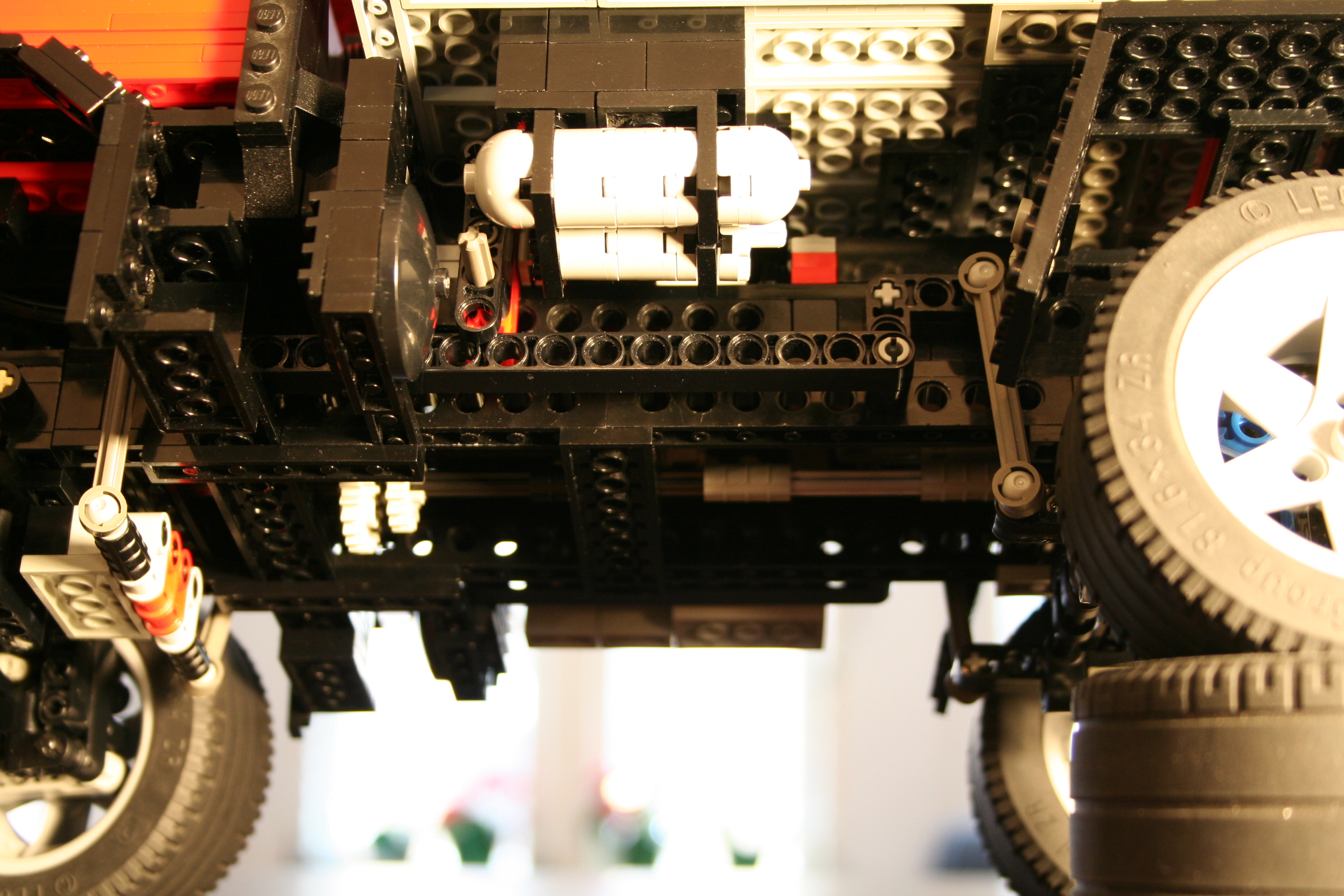
Rumble Bee


It has been six years since I bought my F1 Wheels and Tires.  I bought four, and I paid a lot for them.  To date, I have used them once in my Red Sedan; and only two of the four that I own.  For some reason, I decided I needed to use them again and I wanted to do a small little project.  I was recently reminded about a childhood video game P.O.D. racing, and thought the car I was designing would fit right into the game.
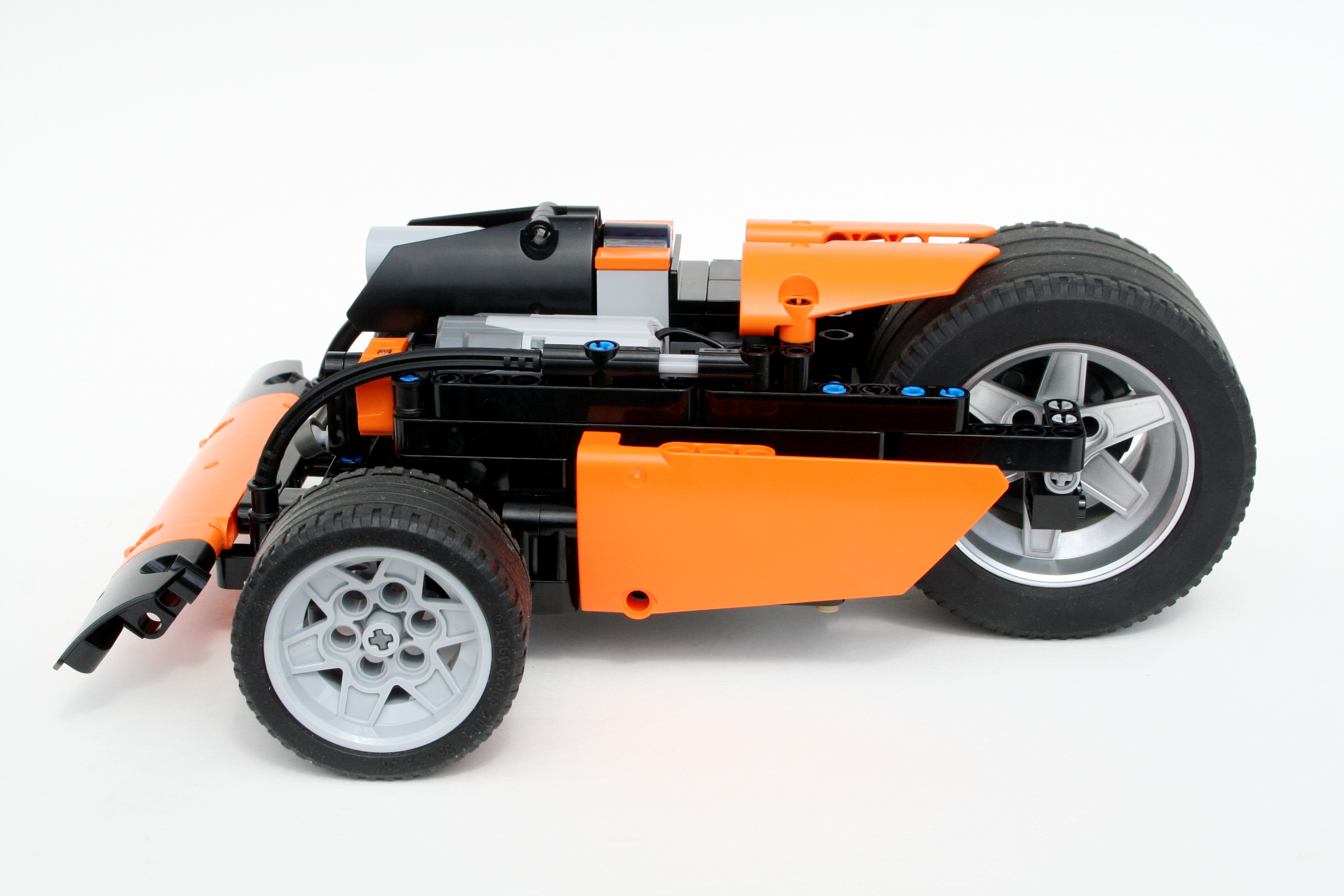
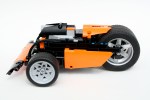
The car is a simple design; a drive motor, a steering motor, a battery box, and a receiver.  I knew I was going to design a three wheel car.  I wanted to have the rear wheel driven by a PF XL, and a single PF M with a simple return to center system for the steering.  After a couple of designs, I decided to place the PF XL motor in the hub of the single rear wheel.  I tried a couple of designs to gear the motor up for a little more speed, all with various locations in the car.  Nothing worked as well as I wanted.  The speed was sufficent, and placing the motor in the hub allowed for a super short wheelbase.

Because the PF XL was place in the rear, I had a lot of space for the rest of the Power Functions equipment.  I placed the battery box directly in front of the rear wheel right at the bottom of the car.  The front steering axle was place next in front of the battery box.  The car had a short wheelbase of only 18 studs.  On top of the battery box, I placed the PF IR reciever and the PF M motor which was for the steering.  The steering motor passed an axle straight through a Spring Loaded Connector to move a 3L liftarm which connected to the steering rack with a 6L steering link.

I added a simple body using the orange panels from 8110.  Keeping with to story of P.O.D. I wanted to keep an agressive stance and look to the car.

The car ran well, and was plenty quick.  The steering was sharp and the car was well planted on the road.  I had a good time with the design.  Now I need to come up with another use for my F1 wheels.

The full gallery may be found here, and instructions here.
Power Functions 4×4 8081


For most LEGO enthusists, when they purchased the set 8081, they quickly modified the set with a Power Functions drivetrain.  It makes sense.  LEGO models are a little more exciting when they are motorized.  But I guess I went a little backwards.  I wanted to do the fun stuff first, and make the most complicated and compact drivetrain I could make.  I posted the instructions here, and they can also be viewed on Rebrickable.com.

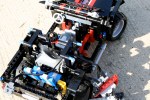
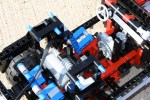
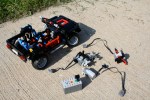
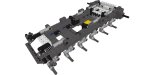
But the comments kept coming from people who wanted to see my model motorized.  So I thought it might be a fun addition.  I added a two PF M motors, a 8878 Battary Box, and an IR receiver.  I tried to keep the modifications simple, so I could easily add the motors to the MOD, and take the system out if I wanted to.  The drive motor was placed on a simple mount that connected to the frame.  The power was fed thought a 8z gear to a 24z gear which then connected directly to the V8 driveshaft.  The driveline was unchanged from the V8 down.  The steering motor was mounted laterally in front of the rear seats.  A 20z double bevel gear drove a 16z gear, then a worm gear moved the final 8z gear which was mounted on the existing HOG steering axle.  I removed the passanger seat which is where I placed the battary box, and created a simple mount for the IR receiver.  The added weight required a new shock absorber, so I added that as well.

The model worked alright.  The drivetrain did well to handle the new power, and I could easily control the Crusier.  The steering motor was a little too powerful for the upside down facing steering rack.  It skipped a little under load, which was a problem over rougher terrain.  The drive motor was a little taxed, so a PF XL would have done a little better.  I guess I could add that, but I am ready to move on to my next model.  Stay tuned.

The full gallery may be found here.

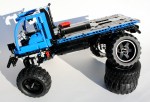
Kenworth T55


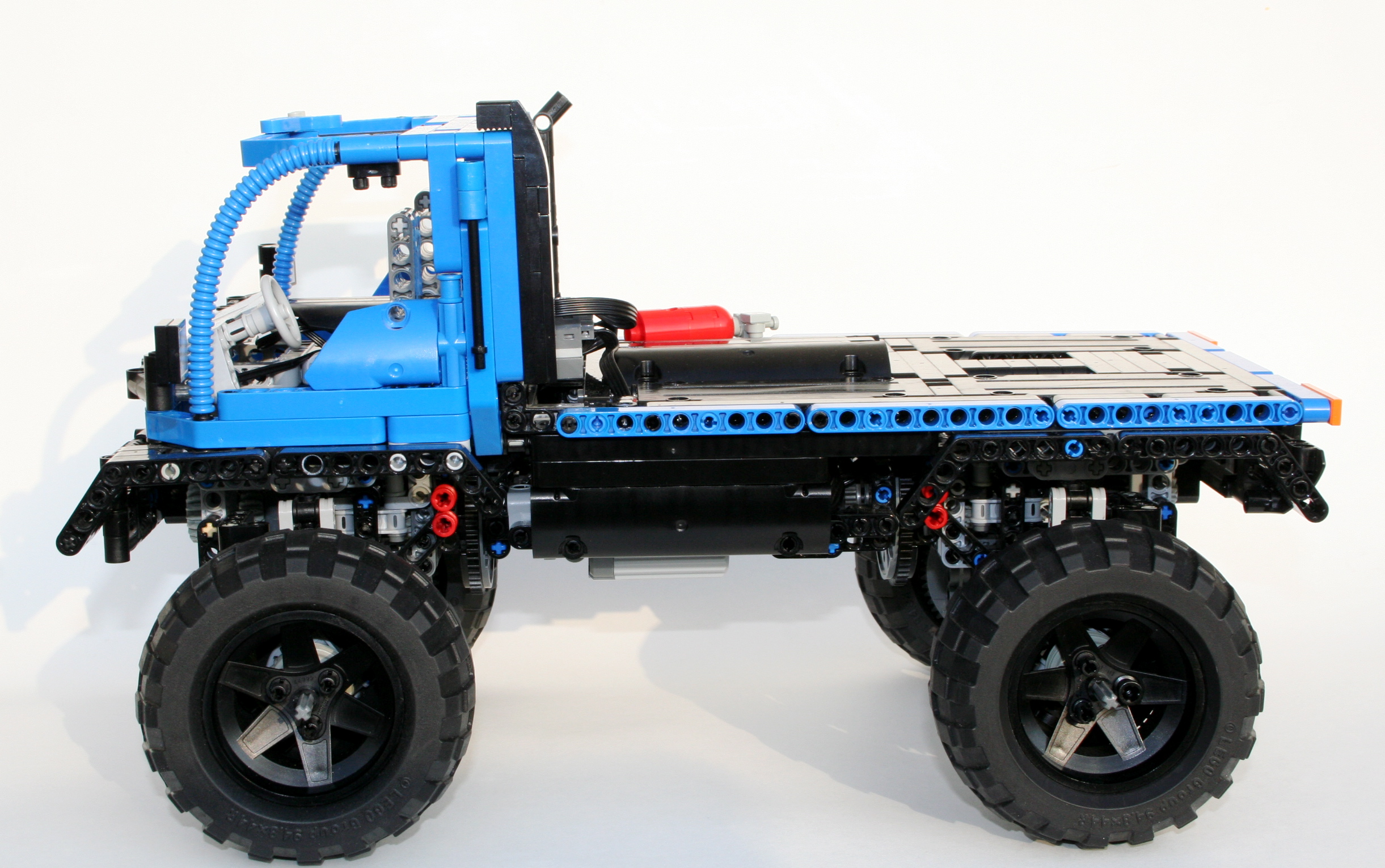
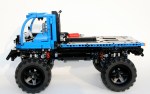
Traction.  It’s all about traction when designing a trial truck.  Because of this, many builders have tried a number of different solutions in designing their own trucks: differentials, gearboxes, various numbers of wheels, various gears ratios, countless suspension designs, and on and on.  So why would it be any different for my trucks?  Every truck I make is a reaction to some set of problems I have encountered with a previous truck.  This is my current solution.

The full gallery is here. Instructions are here.

The Kenworth T55 started as a proof of concept, and turned into a design of a fictional truck.  I wanted to somehow see if there was a way to use differentials in a successful trial truck.  For this to work, two things had to be accomplished.  First, there had to be a way to keep the tires from spinning uncontrollably when they lost contact with the ground.  And second, the torque going through the differential had to be low enough that it would not shred the gears inside the differential when the truck encountered an obstacle.   Could I make axles that had a limited slip differential while having all of the gear reduction at the hub?

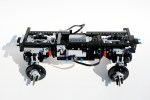
Enter turntables.  I have seen some ideas before, most sigificantly from Borec, including this truck, so I went to work.  I designed a mount for the wheels and tires, and placed the universal joint as close the wheels as I could.  Then I used a limited slip differentail design, and sent the driveshaft back to the body.  A simple steering design was used, and the two fuctions passed through the common design of using a differental body through a turntable.

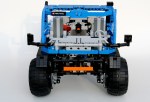
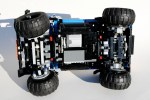
The chassis was designed to keep the weight low, both is mass and location.  As is common, I used the Power Functions XL motor for drive, and I decided to use the 8878 Battery box as it was significally lighter than the other design.  In addition, I would have a drive shaft and a steering shaft running the length of the truck, so the motor and power pack needed to set on both sided of the truck.  Also, because I used the turntables, the drive shaft was very high.  This gave great ground clearance, but I needed to keep the heavy components low.  By having both large components on the side, I was able to keep a short wheelbase of 30 studs, and keep the mass centered and low.  The driveline was complete.

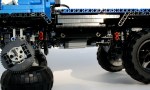
Ever since my GMC 2500, I have held to the belief that a linked suspension is the most efective setup for four wheel trial trucks.  The design keeps all four wheels firmly planned, and does not have the wobbling feel of many pendular suspension designs.  But as is often the case, I ran out of room to place a link rod between the two wheels so I opted with useing the rubber connectors to keep the axles level.    I added a body, and a steering motor, wired everything together, and I was done.

So how did it work.  As you can see in the video, the suspension was effected by the steering and drive shafts.  This further confirms my thoughts on the linked suspension.  Second, the turntables did not really add much.  They added a lot of friction to the driveline, and though they kept the differentials safe because of the tall final gear they did not really isolate the forces on the differential as much as I would have liked.  Third, the limited slip differentials worked well, but still allowed for too much wheel slip.  I ended up replacing the rear with a locked axle, which seemed to work well.  So, for the next truck, bring back the linked suspension, and find a better differential solution.  Maybe then I can find some more traction.

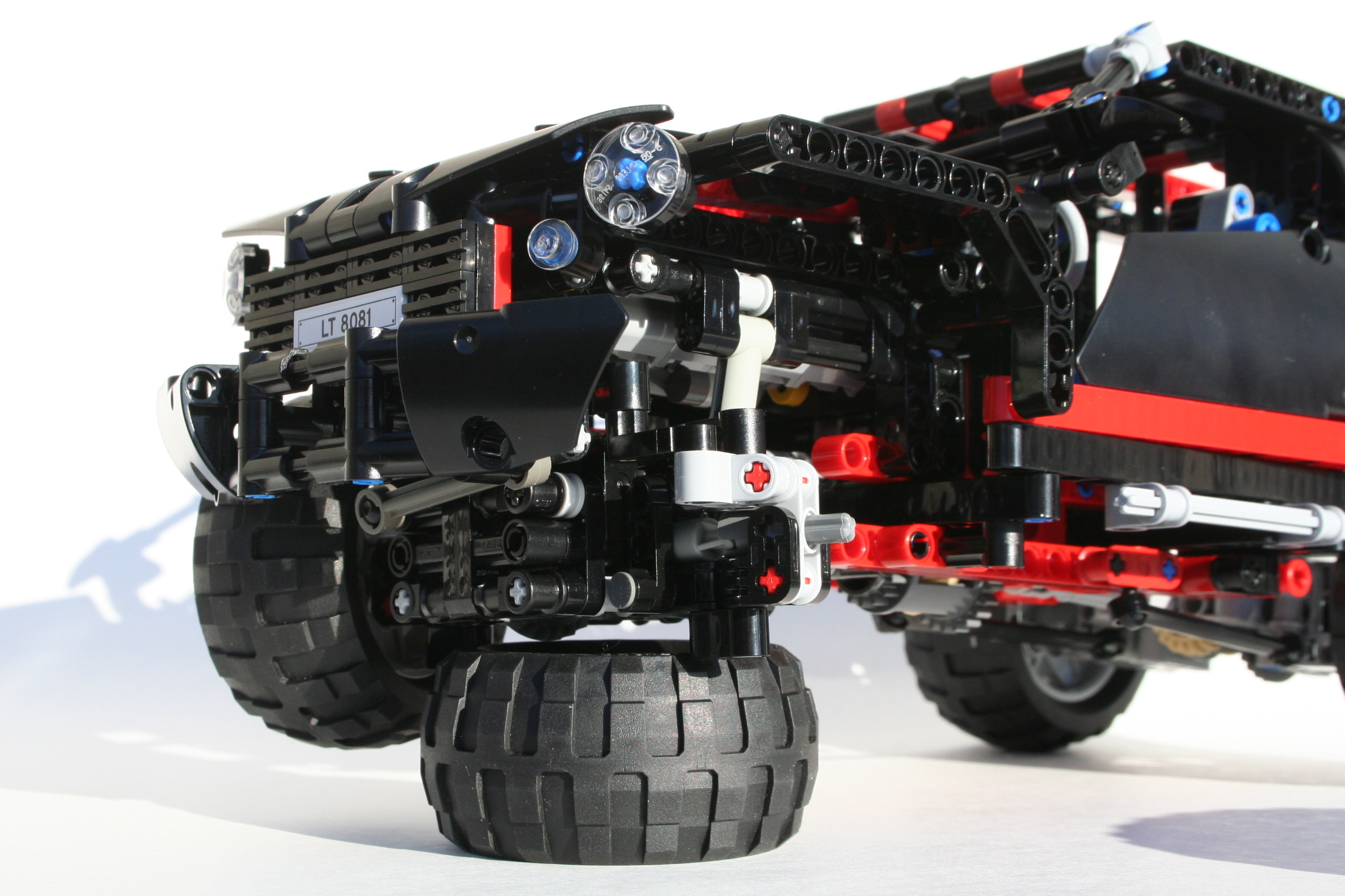
4×4 8081


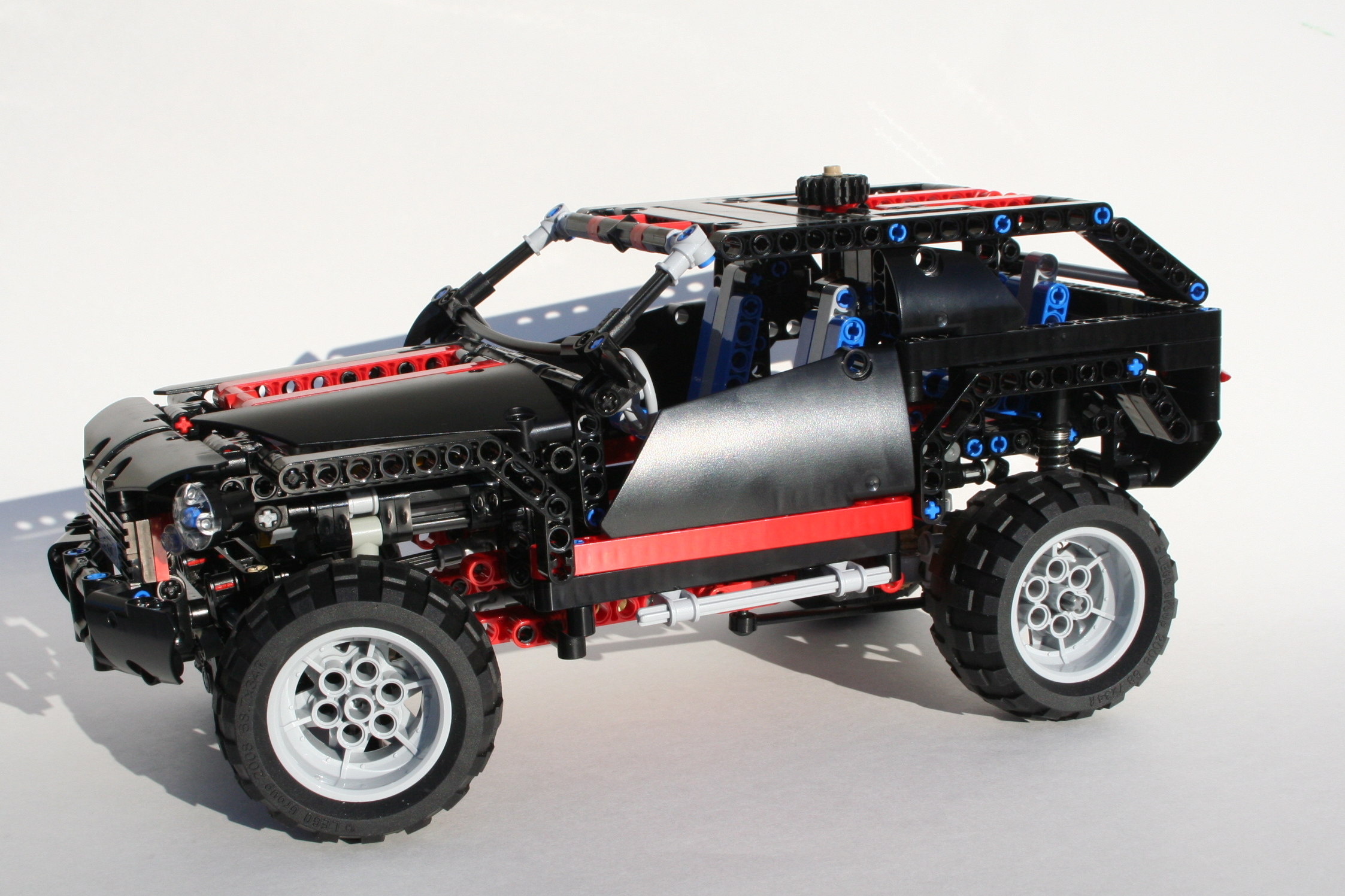
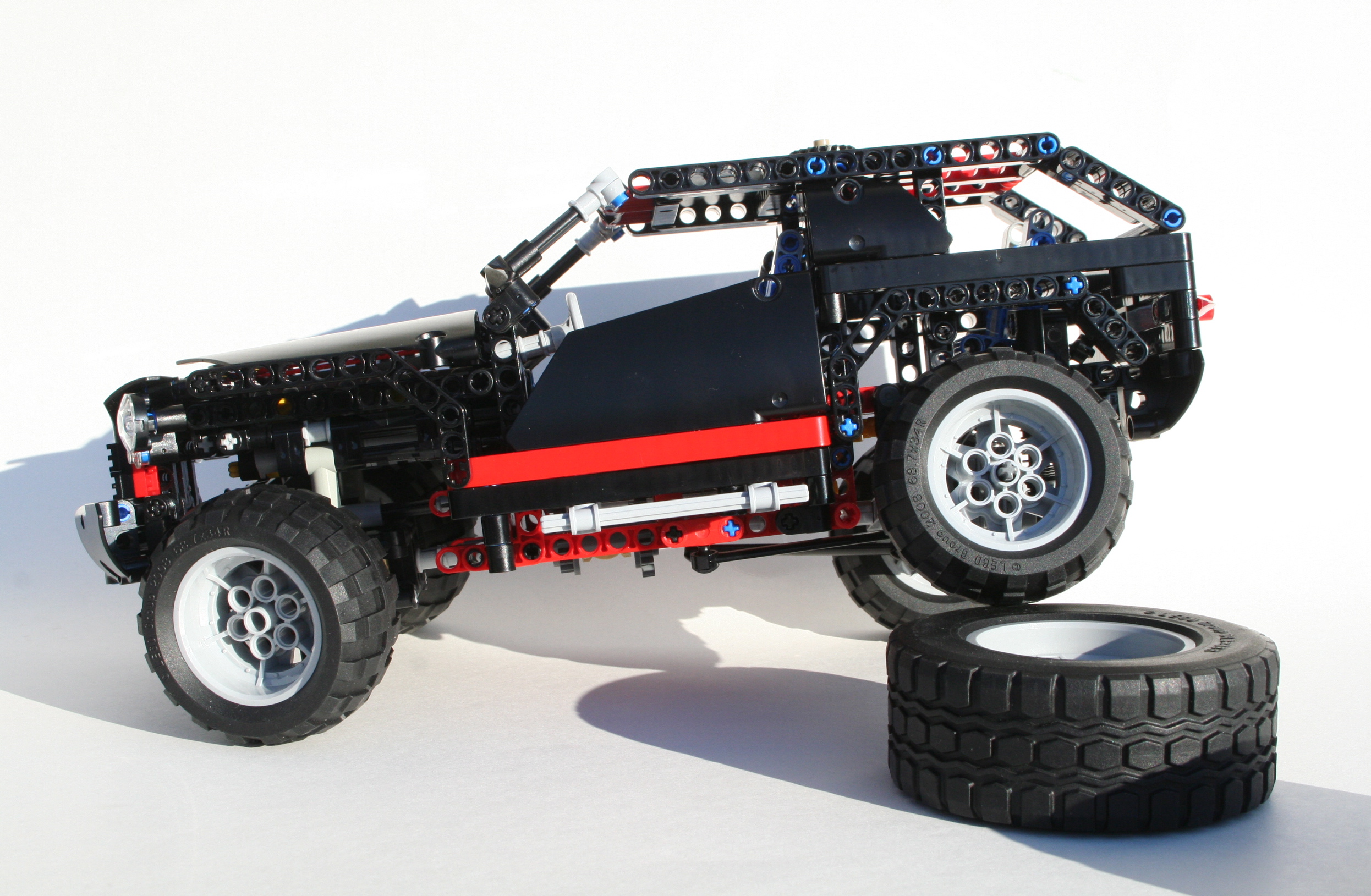
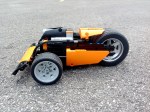
Truthfully, I was excited about set 8081 when it was first announced.  I liked the size.  I liked the coloring. I liked the stance.  But mostly I liked the potential.  Most of the Technic community dismissed the 8081 because of its watered down functions, but I was interested in making some changes to see if I could make the Cruiser Extreme.

The full gallery can be found here, and instructions here.
Image

I first added a V-8.  There was plenty of room, and after seeing a great modification from Efferman, I had some ideas.  It was a simple addition.

Image

Next was the drivetrain.  This was a little more complicated.  I wanted to make it four wheel drive, and I wanted to make sure there were three differentials.  I rebuilt the rear axle, so It would have a more active setup.  I put in longer shocks, and added a Panhard rod, and two stabilizing links.  It worked well.  The front axle was more challenging.  The new CV joints made the project a little easier.  Once I had the differential place, I had to fit everything around it.  The steering rack was placed upside down, and was connected directly to the existing steering link in the original 8081.  Then I added a Panhard rod on the front of the axle, and rebuild the front bumper, and everything was set.

ImageImageImage

Instructions can be found at Rebrickable.com or here.

Full gallery is here.
I also created a motorized version after a number of requests.  You may see the gallery for that MOD here.
T-72


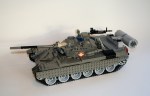
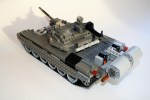
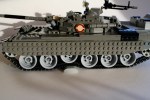
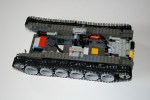
As a child I always wanted a model of the Russian T-72, so I decided to create a version of the tank out of LEGO bricks.  As is often the case, the model started with wheels.  This determined the scale, and from there, I was able to determine the rest of the tank dimensions.  This gave me very little room for all the functions of the tank.

Instructions are available for $5 USD.  Buy Now Button

Model of the popular Russian T-72. View the full gallery here.

The tank includes independent suspension on all 12 of the drive wheels.  6 are suspended with 6.5 length shock absorbers, 4 are suspended with rubber connectors, and the final two are not suspended, but move freely with the track.  The tracks are driven from the rear by two longitudinally mounted PF M motors.   These are connected 1:1, through double bevel gears to the 24z sprockets.  The battery box is place in the front of the tank, with the IR receivers placed over the drive motors.  The final PF M is mounted vertically in the turntable, to rotate the turret.  It could use another reduction, as the rotation is a little quick as you can see below.

I was pleased with the way this model turned out.  While the functions work alright, the aesthetics of the tank represented the original well.

The full gallery may be found here.